Do Electric Wine Openers Work on Synthetic Corks?
Most electric wine openers will pull a synthetic cork, but the material causes more friction than natural cork and a few openers handle it better than others.
Synthetic corks are made from plastic or foam compounds and have become common on bottles priced under $20. They grip the inside of the bottle neck more firmly than natural cork, which means the motor in an electric opener has to work harder. The short answer is yes, the majority of electric wine openers can remove a synthetic cork without a problem. The longer answer depends on how powerful the motor is and how well the worm screw is designed to bite into a dense material.
Products mentioned in this post


Why Synthetic Corks Are Harder to Pull
Natural cork is a porous material that compresses slightly when the worm screw threads into it, then releases tension as it is drawn upward. Synthetic cork is more rigid and does not compress the same way. That means the screw has to grip a slicker surface and the motor must sustain torque all the way through the pull. On cheaper openers with small motors, you may feel the device strain or hear it slow down near the end of the extraction. In most cases the cork still comes out, but it takes a second or two longer than a natural cork does.
What the Worm Screw Design Has to Do With It
The worm screw, sometimes called the spiral or helix, is the metal coil that bores into the cork. A screw with widely spaced threads and a sharp tip penetrates synthetic material more cleanly. A shallow or dull screw can skip along the surface of a dense synthetic cork before it gets purchase, which puts extra strain on the motor and occasionally causes the cork to strip rather than pull. When shopping, look for openers that describe a stainless-steel worm screw with a pointed tip. Budget openers under $15 sometimes use plated steel that dulls faster and is less effective on synthetic material.
Battery and Charge Capacity Matter More With Synthetic Corks
Because synthetic corks require more torque, they draw down a battery charge faster than natural corks do. An opener that claims 30 to 50 bottles per charge on natural cork may deliver noticeably fewer when used primarily on synthetic. A good practice is to keep the opener charged after every few uses rather than waiting until it feels sluggish. Openers in the $23 to $30 range, such as the Secura KP1-36N2 (rated 4.4 stars across 37,600 reviews at around $23), are popular partly because buyers report consistent performance on both cork types across many charge cycles.
Foil Cutters and Synthetic Corks
Many electric opener sets include a foil cutter. Synthetic-cork bottles typically use the same foil capsule as natural-cork bottles, so the foil cutter works the same way regardless of what is underneath. This is not a factor that affects which opener you choose for synthetic corks, but it is worth knowing that the foil step is identical either way. Sets like the Ivation IVAWINESET05 (4.6 stars, around $60) include the foil cutter and a vacuum wine stopper in the kit, which gives you more value even though the cutter itself is not affected by cork type.
Openers That Handle Synthetic Corks Reliably
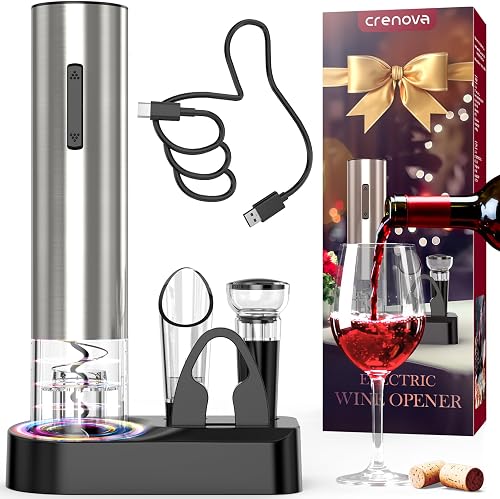
Based on review counts and ratings, a few models stand out. The Secura KP1-36N2 has over 37,000 reviews and a 4.4-star rating at roughly $23, making it one of the most validated options at a budget price. The Moocoo KP3-361802D-BS carries a 4.7-star rating from about 2,900 reviewers at around $35, and buyers frequently mention clean pulls on both natural and synthetic closures. The Crenova WO-213B Mini weighs only 0.45 lb, carries a 4.6-star rating from 1,400 reviewers, and its compact form is built around a motor sized for quick single-bottle use, including synthetic corks. Any of these three offer a reliable choice without requiring a high budget.
What Electric Openers Cannot Do Well With Synthetic Corks
Some wineries use a particularly stiff injection-molded synthetic closure that is nearly the density of hard plastic. These are less common but do exist, mainly on sparkling wines or certain European producers. On those closures, even a good electric opener may struggle, and a two-step lever-style manual corkscrew often does better because you can apply controlled sideways force. If you open a lot of sparkling wine with synthetic closures, be aware that some sparkling wine closures are mushroom-shaped and cannot be removed by a worm-screw tool at all, electric or manual. That is a cork-shape issue, not an electric-vs-manual issue.
Getting the Best Results Every Time
Center the opener on the bottle neck before pressing the button so the screw enters straight. A crooked angle is the most common reason for a partial pull or a stripped cork, especially with the firmer synthetic type. Hold the bottle still with your other hand rather than pressing down on the opener. Let the motor do the work at its own pace rather than adding downward pressure, which can bend the screw on lighter openers. After each use, wipe the screw clean because synthetic cork sometimes sheds small particles that can gum up the threads over time.
Frequently asked questions
Will an electric wine opener damage a synthetic cork?
In normal use the opener removes the cork intact. If the worm screw is dull or enters at a crooked angle, it can tear the surface of a synthetic cork, but the cork still comes out and the wine is unaffected. Using the opener straight and centered prevents most tearing.
How can I tell if a bottle has a synthetic cork before I open it?
Look at the top of the capsule after you cut the foil. Synthetic corks are usually bright white, light tan, or a uniform solid color with no visible grain or pore pattern. Natural cork has an irregular texture and may show bark grain. Some synthetic corks also have the producer name embossed in the plastic.
Do I need a different opener for synthetic corks versus natural corks?
No. A quality electric opener handles both without any adjustment. The only reason to think about cork type when buying is to choose a model with a well-made worm screw and enough motor power to sustain torque through a slightly resistant pull.
Why does my electric opener stop partway through pulling a synthetic cork?
The most common causes are a low battery, a dull or bent worm screw, or holding the opener at an angle so the screw binds against the bottle neck. Charge the opener fully, inspect the screw for damage, and make sure it is centered vertically over the cork before starting. If it continues to stop, the motor may be underpowered for dense synthetic closures and a step-up model is worth considering.
Can I use an electric opener on a sparkling wine bottle with a synthetic closure?
Standard sparkling wine is sealed with a mushroom-shaped cork held by a wire cage, and no worm-screw opener works on that style. A small number of lower-pressure sparkling wines use a cylindrical synthetic cork similar to still wine, and an electric opener works fine on those. Check whether the bottle has a wire cage before reaching for the electric opener.