How Much Counter Space Does a Countertop Dishwasher Need?
Countertop dishwashers come in two distinct size classes, and knowing the difference before you buy can save you a frustrating return.
Countertop dishwashers are sized for kitchens where a full built-in simply is not an option, but they still take up real estate on your counter. Most models fall into one of two footprint ranges, and the gap between them is significant enough to matter in a tight space. Before you order, measure the spot you have in mind and account for a few inches of clearance on each side. This guide walks through the numbers so you can shop with confidence.
Products mentioned in this post


The Two Standard Footprint Sizes
Compact countertop dishwashers, sometimes called mini or portable pod dishwashers, typically measure around 16 to 17 inches wide and 16 to 17 inches deep. Standard-capacity countertop models, which hold six place settings, run closer to 19.5 to 20 inches wide and 21.5 to 22 inches deep. That extra five inches of depth is the dimension most shoppers overlook because counter depth is the scarce resource in most kitchens. The NOVETE TDQR01, for example, measures 16.75 x 16.84 x 18.05 inches and weighs 28 pounds, while the COMFEE' CDC22P1BBB measures 19.7 x 21.7 x 17.2 inches and weighs 46 pounds. Both are countertop units, but they call for very different footprints.
Minimum Clearance You Should Leave
Beyond the unit itself, plan for a few inches of breathing room. Leave at least 2 inches on each side so heat and steam can escape without damaging adjacent cabinets or walls. The door swings open toward you, so you need clear floor space in front as well as counter clearance above the open door. Most models stand 17 to 18 inches tall, and you will need another inch or two above that for the door to hinge fully open. Check your upper cabinets before positioning the unit, since low-hanging shelves are a common reason countertop dishwashers end up stored in closets.
Water Connection and Cord Space
Almost every countertop dishwasher connects to a kitchen faucet via a quick-connect adapter, so you need to be within reach of the sink. The standard inlet hose is around 5 to 6 feet long and the drain hose is similar, so placing the unit more than roughly 4 feet from the faucet will cause problems. The power cord on most 120-volt models is 5 to 6 feet long as well. Factor in where the nearest outlet sits relative to your planned location, and avoid running cords across high-traffic areas where someone could trip. If your counter runs along the wall opposite the sink, the hose lengths may not reach without an extension, which most manufacturers do not recommend.
What Fits on a Standard Kitchen Counter
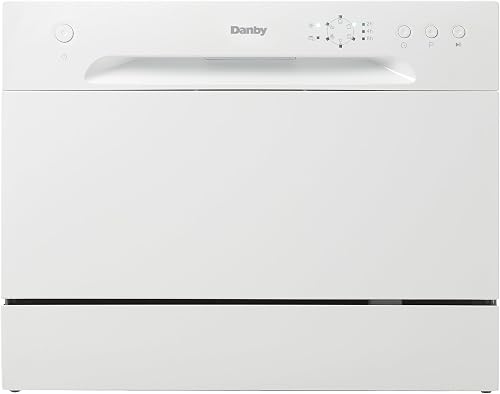
A typical American kitchen counter is 25 to 26 inches deep. A compact unit around 17 inches deep leaves 8 to 9 inches between the back of the machine and the front edge, which is workable but snug. A standard-capacity model at nearly 22 inches deep leaves only 3 to 4 inches of overhang clearance. In practice, that means a standard-capacity countertop dishwasher sits close to the front edge of the counter, which can feel precarious if the surface is not level. The Danby DDW621WDB, at 19.69 x 21.65 x 17.24 inches and 46.3 pounds with a 4.4-star rating from over 2,000 owners, is a good example of a heavier standard-capacity unit where placement stability matters.
Island and Cart Placement
If counter space is truly limited, a kitchen island or rolling cart can work as an alternative surface. The cart needs to be sturdy enough to hold at least 30 to 50 pounds without wobble, since vibration during cycles can walk a lighter unit toward the edge. Some owners use a non-slip mat under the machine for extra stability. The faucet-connection hose still needs to reach the sink, so measure carefully before committing to an island position. A cart on wheels can be rolled to the sink for setup and then moved slightly away, but a unit this heavy should not be relocated every cycle.
Planning for a Temporary vs. Permanent Spot
If you plan to leave the unit plugged in and connected between uses, the counter location is effectively permanent, so treat it like any fixed appliance and confirm the dimensions fit before buying. If you prefer to store it in a cabinet or closet and bring it out for each use, weight becomes the dominant factor. A compact model at 26 to 30 pounds is far easier to lift than a standard-capacity model at 44 to 50 pounds. Repeated lifting of heavier units is a common complaint among owners who did not think through the storage plan. Decide on your workflow first, then choose the size that matches it.
Frequently asked questions
Can a countertop dishwasher sit on top of the refrigerator?
It is not a good idea. The water inlet hose still needs to reach the kitchen faucet, which is typically too far from the refrigerator. The top of most refrigerators is also not a level, stable surface, and the vibration from the dishwasher cycle can damage the fridge finish or cause the unit to shift.
How much counter depth do I need for a countertop dishwasher?
A compact model around 17 inches deep fits on a standard 25-inch counter with room to spare. A standard-capacity model at 21 to 22 inches deep will sit only 3 to 4 inches from the front edge, which is safe but tight. Measure your specific counter and compare it to the product dimensions listed in the specs before buying.
Do I need to keep the countertop dishwasher near the sink?
Yes. The quick-connect hose that attaches to your faucet is typically 5 to 6 feet long, and the drain hose is similar. The unit needs to be within that range of the sink to operate correctly. Placing it more than a few feet away will require hose extensions that most manufacturers do not support.
What happens if I put the dishwasher too close to the wall?
Heat and steam need room to dissipate. Placing the unit flush against a wall or cabinet can trap moisture against the surface and cause water damage or warping over time. A minimum of 2 inches on each side is a practical guideline. Check the manual for the specific model you buy, since clearance requirements can vary.
Can I use a countertop dishwasher on a rolling cart?
Yes, if the cart is rated for the weight and is stable without wobble. A compact unit at 26 to 30 pounds is easier to manage on a cart than a standard-capacity model at 44 to 50 pounds. Lock the wheels during operation and confirm the hose can still reach the faucet from wherever the cart is positioned.