How to Grind Your Own Meat at Home
Grinding your own meat gives you control over fat content, freshness, and texture that no pre-ground package can match.
Store-ground beef is convenient, but it can combine trimmings from many animals and sit in a display case for days. When you grind at home, you choose the cut, control the fat ratio, and send it straight from grinder to pan. The process takes about ten minutes once your equipment is cold and your meat is prepped. This guide walks through every step, from selecting cuts to cleaning up safely.
Products mentioned in this post


Choose the Right Cut
The cut determines the flavor and fat level of your finished grind. Chuck is the most popular choice for burgers because it sits around 80 percent lean and has enough fat to stay juicy. Brisket adds a beefier, richer flavor and works well blended with chuck at a roughly 50/50 ratio. Sirloin is leaner, closer to 90 percent, and suits meatballs or meat sauces where you want less grease in the pan. For pork sausage, shoulder (also called Boston butt) carries the fat marbling that keeps links moist after cooking. Whatever you pick, buy in larger pieces rather than pre-cut stew meat so you can control the trim.
Chill Everything Before You Start
Cold meat grinds cleanly. Warm meat smears, clogs the auger, and can leave a paste-like texture instead of distinct ground strands. Cut your meat into 1-inch cubes, spread them on a sheet pan, and freeze for 20 to 30 minutes until the edges are firm but the center is not fully frozen. Do the same with the grinder parts: put the blade, plate, and auger in the freezer for the same window. Keeping every surface near freezing also slows bacterial growth during the grinding process, which matters for food safety.
Set Up the Grinder
Assemble the grinder according to its manual before the meat comes out of the freezer. Most electric home grinders use a coarse plate (around 3/8-inch holes) for a first pass and a fine plate (around 3/16-inch holes) for a second pass if you want finer texture. For burgers, a single pass through the coarse plate gives a looser, more open texture that many cooks prefer. Attach the grinding plate and blade firmly so there are no gaps that could let meat slip past the blade uncut. Place a chilled bowl or sheet pan under the output to catch the ground meat.
Feed the Meat Steadily
Turn the grinder on before you start feeding. Drop cubes one at a time into the hopper rather than packing them in, which can jam the auger. Use the provided pusher, not your fingers, to press cubes toward the worm gear. A steady, moderate pace lets the blade shear cleanly. If you hear the motor laboring or see the meat smearing rather than emerging in distinct strands, stop, disassemble, and check for sinew or connective tissue wrapped around the blade. That tissue is the most common cause of clogging and poor texture.
Season and Handle Safely
Season ground meat right before cooking, not before grinding. Salt draws moisture out of the proteins and can change the texture of the grind if left to sit. For burger patties, form them with a light hand and press a small indent in the center so they cook flat. For sausage, mix in your spices and any liquid (water or wine) thoroughly before stuffing or forming links. Keep ground meat refrigerated and use it within one to two days, or freeze it the same day you grind it for best quality.
Clean the Grinder Right Away
Disassemble the grinder immediately after use. Run a slice of bread through the grinder to push out the last of the meat before disassembly, then take apart the auger, blade, and plate. Wash all metal parts in hot soapy water, rinse well, and dry completely before storing to prevent rust. Never submerge the motor housing in water. Most plates and blades are not dishwasher-safe because the heat can dull the cutting edge. If your grinder came with a brush, use it to clear the holes in the grinding plate.
Picking a Home Meat Grinder
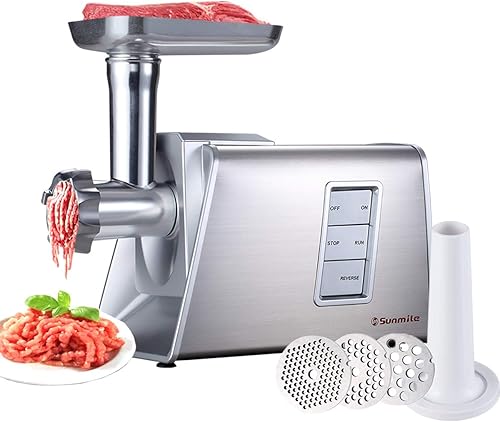
For occasional home use, an 800 to 1000 W grinder handles a few pounds of chuck without overheating. The Sunmile SM-G35 (800 W, 4.4 stars across 2,900 ratings, $46.99) is a popular entry point that weighs 7.3 lb and measures 14.76 x 7.68 x 14.17 inches, so it fits most counters without dominating the space. The Sunmile SM-G73 steps up to 1000 W and 796 ratings at 4.4 stars for $79.99 at 5.53 lb. If you grind in volume or want more headroom, the Aaobosi MG102A carries a 3000 W rating, weighs 4.29 lb, and holds 4.5 stars from 1,681 buyers at $109.97. Match the wattage to how much you plan to grind per session rather than buying more machine than your routine needs.
Frequently asked questions
Do I need to freeze the meat before grinding?
You do not need to freeze it solid, but chilling the cubes until the edges are firm makes a real difference. Meat that is close to fridge temperature (around 34 to 38 degrees Fahrenheit) still tends to smear if the grinder parts are warm. A 20 to 30 minute stint in the freezer gets the meat firm enough to shear cleanly, and chilling the grinder parts at the same time keeps the contact surfaces cold throughout the session.
Can I grind frozen meat?
Fully frozen meat is too hard and will strain the motor, potentially damaging the auger or blade. Partially frozen is the sweet spot, where the surface is firm but a knife can still pierce the center. If your meat came from the freezer, thaw it in the refrigerator until it reaches that semi-firm stage rather than defrosting at room temperature, which lets the outer layer warm up while the core stays frozen.
Why is my ground meat coming out pasty?
Pasty texture almost always means the meat or grinder parts were too warm. Fat softens quickly and smears instead of breaking into distinct pieces when temperatures rise above about 40 degrees Fahrenheit. Connective tissue or sinew wrapped around the blade can also cause this by slowing the cut. Stop the grinder, remove and clean the blade and plate, re-chill everything, and resume with smaller cubes fed at a slower pace.
Is it safe to eat home-ground beef medium or medium-rare?
The USDA recommends cooking ground beef to 160 degrees Fahrenheit internal temperature because grinding distributes any surface bacteria throughout the meat. When you grind at home from a single whole muscle you trim yourself, the risk profile is lower than commercial ground beef that mixes many sources, but it is not zero. If you want to serve burgers at a lower internal temperature, sear the exterior first, which kills surface bacteria, or use a cut with minimal prior handling.
What plate size should I use for burgers versus sausage?
A coarse plate with 3/8-inch holes works well for burgers because it leaves a more open, chunky grind that stays juicy and has a satisfying bite. Sausage benefits from a finer plate, around 3/16-inch, which creates a tighter bind and helps the meat hold together in a casing or as a patty. Some cooks do two passes for sausage: coarse first, then fine, which gives a smooth but not paste-like texture.