Countertop vs Portable Dishwasher: What Is the Real Difference?
Recommended picks


How Each Type Connects to Your Sink
Both types use a faucet adapter rather than a dedicated water line, so neither requires a plumber. Countertop dishwashers ship with an inlet hose you thread onto the faucet aerator before each cycle, then disconnect when done. Portable dishwashers use the same quick-connect method but have longer hoses because the machine sits on the floor several feet from the sink. If your faucet has a non-standard aerator thread or a pull-out spray head, you may need an adapter for either type, so check your faucet specs before ordering. The drain hose on both styles hooks over the edge of the sink by gravity, no standpipe needed.
Capacity: How Many Dishes Each Type Can Handle
This is the biggest practical gap between the two formats. Most countertop dishwashers hold 2 to 6 place settings per load. The COMFEE' CDC22P1BBB, for example, lists a 6-place-setting capacity in dimensions of 19.7 x 21.7 x 17.2 inches and weighs 46 pounds at $278.98. The NOVETE TDQR01 is more compact at 16.75 x 16.84 x 18.05 inches, weighs just 28 pounds, and is rated 4.4 stars across 2,400 reviews at $289.99. Portable full-size dishwashers, by contrast, match a built-in machine in rack space, typically 8 to 12 standard place settings, and can fit large pots, sheet pans and tall glasses that countertop racks cannot accommodate. If you regularly wash cutting boards, mixing bowls or baking sheets, a portable unit is the more practical choice.
Space and Storage Requirements
Countertop dishwashers need a clear countertop footprint of roughly 17 to 22 inches wide and 17 to 22 inches deep, plus access to a nearby faucet. Because they sit at counter height, they are easy to load without bending. Portable dishwashers are typically 24 inches wide and stand about 36 inches tall on casters, so they need a floor path clear enough to roll to the sink and then be pushed back into a closet or corner after each use. Apartments with galley kitchens or narrow layouts often struggle to accommodate a rolling portable unit, which is why countertop models have become popular in smaller homes. Measure both your available counter depth and your floor clearance before deciding.
Noise Levels to Expect
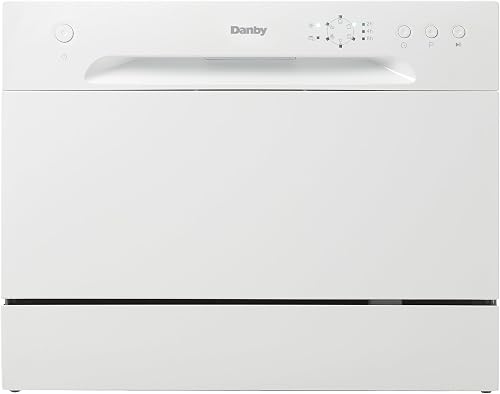
Because countertop dishwashers are smaller and sit right on the counter at arm's length, noise ratings matter more than they might for a built-in unit tucked under a cabinet. The Danby DDW621WDB, rated 4.4 stars from 2,008 reviews at $486.48, runs at 52 dB, which is roughly the sound level of a normal conversation. The NOVETE TDQR01 runs at 50 dB, while some compact models in this category reach 60 to 62 dB. Portable dishwashers are also compact by full-size standards but typically sit farther from your seating area on the floor, so their noise is less intrusive. If you run the dishwasher while watching TV or working nearby, look for a countertop model rated 52 dB or lower.
Cost Comparison
Countertop dishwashers in this category generally range from around $270 to $540, with most well-reviewed options landing between $280 and $370. Portable full-size dishwashers typically start around $400 and can run past $700 for models with more wash programs or better noise ratings. The price gap narrows when you factor in that a portable unit washes nearly twice as many dishes per load, which can mean fewer cycles per week. If your budget is tight and your household is small, a countertop model offers solid value. For a family of three or four who wants to avoid hand-washing larger items, the higher upfront cost of a portable unit often pays off in daily convenience.
Which One Is Right for You
Choose a countertop dishwasher if you live alone or with one other person, have limited floor space, and mostly wash plates, glasses and everyday utensils. The NOVETE TDQR01 at $289.99 and the COMFEE' CDC22P1BBB at $278.98 are both well-reviewed options with over 2,000 ratings each. Choose a portable dishwasher if you cook regularly for three or more people, need to wash large cookware, or want full-size wash performance without a permanent install. Either way, confirm that your faucet aerator accepts a standard quick-connect adapter before buying, because that is the one compatibility issue that affects both formats equally.
Common mistakes to avoid
- Buying based on listed place settings without checking the actual interior dimensions, since some compact countertop models cannot fit standard dinner plates larger than 10 inches.
- Assuming any faucet works out of the box. Pull-out faucets and some single-handle models need a separate adapter not always included in the box.
- Placing a countertop dishwasher on an unstable surface. These units vibrate during the wash cycle and need a flat, level counter that can support 28 to 50 pounds.
- Overlooking noise ratings when the unit will run near a living space. A 62 dB machine is noticeably louder than a 50 dB one, especially on a hard countertop that amplifies vibration.
- Skipping the water temperature check. Most countertop and portable dishwashers require incoming hot water of at least 120 degrees Fahrenheit for proper cleaning. If your water heater is set lower, wash results will suffer.
- Buying a portable dishwasher without measuring the roll-out path. A 24-inch-wide unit on casters needs a clear floor route from its storage spot to the sink, which rules out many galley and U-shaped kitchens.
Frequently asked questions
Do countertop dishwashers use more water than washing by hand?
Most countertop dishwashers use 2 to 4 gallons per cycle, while hand-washing a similar load under a running tap typically uses 8 to 15 gallons. So a countertop machine is almost always more water-efficient than hand-washing, even for a small load. The exact figure varies by model and wash program, but efficiency is rarely a reason to avoid buying one.
Can I leave a countertop dishwasher connected to the faucet full time?
Most manufacturers do not recommend leaving the inlet hose connected between cycles because constant water pressure on the quick-connect fitting can cause slow drips over time. It takes about 30 seconds to connect and disconnect the hose, and doing so protects both the fitting and your faucet aerator. If convenience is a priority, some users add a small shutoff valve to the faucet line so they can leave the hose attached but cut the pressure.
Will a portable dishwasher fit in a small apartment?
It depends on your floor plan. A standard portable unit is 24 inches wide, 24 to 25 inches deep, and about 36 inches tall, which is comparable to a small refrigerator footprint. You need a clear path to roll it to the sink, and your sink must be close enough that the supply and drain hoses reach. In very small or galley-style kitchens, a countertop dishwasher is usually the more practical fit.
How long does a typical countertop dishwasher cycle take?
Most countertop dishwashers complete a standard wash cycle in 45 to 90 minutes, depending on the selected program. Quick or eco modes on some models finish in under 30 minutes but use higher temperatures or shorter rinse times. Heavier wash modes that handle greasy pots can run up to two hours. Check the cycle time specs for the specific model you are considering if turnaround speed matters for your routine.
Is installation required for either type?
Neither a countertop nor a portable dishwasher requires permanent installation or a plumber. Both connect to a standard kitchen faucet using a threaded adapter that typically takes a few minutes to attach. The main setup step is verifying that your faucet aerator has a compatible thread size, usually 15/16 inch male or 55/64 inch female, and using the included adapters to match. Contact hello@shopperscout.com if you have questions about compatibility with a specific faucet type.