How to Choose a Countertop Dishwasher
Recommended picks


Capacity: How Many Dishes Do You Actually Wash?
Countertop dishwashers split into two practical groups. Compact models like the NOVETE TDQR01 hold roughly 1.3 gallons and suit one-person households or supplemental use for glasses and mugs. Larger machines rated for six place settings, such as the COMFEE' CDC22P1BBB (rated by 3,500 buyers at 4.2 stars and priced at $278.98), handle full sets of dishes for two people per cycle. If you regularly cook for more than two people, you will run the machine multiple times per day on a six-place-setting unit, which may make a full-size portable dishwasher a better fit. Think honestly about your daily dish count before settling on a size.
Noise Level: Decibels Matter More Than You Think
Countertop dishwashers sit right on the counter at ear level, so noise is more noticeable than with an under-counter unit. Models in the 50 to 52 dB range, like the NOVETE TDQR01 at 50 dB and the COMFEE' CDC22P1BBB at 52 dB, run quietly enough for open-plan kitchens and apartments. Units rated at 60 dB or above are noticeably louder and may be disruptive during phone calls or TV watching. Check the spec sheet for a dB rating before buying, since many budget listings omit it entirely.
Water Connection: Faucet Adapter vs. Built-In Tank
Standard countertop dishwashers connect to your kitchen faucet via an adapter that threads onto the aerator. The machine fills, washes, and drains through a hose into the sink. This setup works fine in most kitchens, but the faucet adapter must match your faucet thread size, and some pull-down faucets are not compatible. A smaller group of compact units, particularly ultra-small models under 10 lbs, use a built-in water reservoir you fill by hand, which means no connection at all but also much smaller wash loads. Confirm which type you are buying and check adapter compatibility with your faucet model before ordering.
Footprint and Counter Space
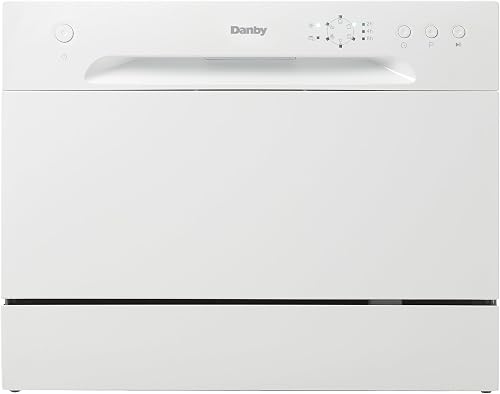
Full-size countertop dishwashers are not small appliances. The Danby DDW621WDB, a well-reviewed machine with 4.4 stars across 2,008 ratings priced at $486.48, measures approximately 19.7 by 21.7 by 17.2 inches and weighs 46.3 lb. That is nearly 22 inches from front to back on your counter, plus clearance for the drain hose. Compact single-person models shrink down to around 16 by 17 inches, which is a meaningfully smaller claim on counter space. Measure your available counter space, including height clearance under upper cabinets, before deciding on a form factor.
Voltage and Outlet Requirements
Nearly all countertop dishwashers sold in the United States run on 120-volt standard outlets. A small number of compact imports are rated for 220 volts, which is a different outlet type. Verify the voltage spec on any model you consider, particularly if the listing shows a brand you are less familiar with. Running a 220-volt appliance on a 120-volt outlet with an adapter is not safe and will not give you a proper wash. Stick to 120-volt units for plug-and-play use in any standard American kitchen.
Controls and Wash Programs
Most countertop dishwashers use touch controls and offer four to six wash programs including normal, heavy, eco, glass, and a quick rinse. Touch panels are easy to wipe clean. Push-button controls are simpler and less prone to accidental activation, which some buyers prefer. Programs that matter most in daily use are a quick cycle for lightly soiled items and a heavy cycle for baked-on food. Fancy programs like fruit wash or baby bottle cycle are narrow-use additions that rarely drive a buying decision.
Common mistakes to avoid
- Buying by price alone without checking noise level, then discovering the machine runs at 60 dB in an open kitchen.
- Not measuring counter depth before ordering a full-size unit that runs 21 to 22 inches deep.
- Assuming a faucet adapter will fit any faucet, then finding the thread size or faucet style is incompatible.
- Choosing a 2-place-setting compact unit for a two-person household, which forces two or three cycles per meal.
- Ordering a 220-volt import without checking the outlet type, making the machine unusable without an electrician.
- Ignoring the drain hose length and placement, then finding the hose does not reach the sink from where the machine sits.
Frequently asked questions
Do countertop dishwashers need to be permanently connected to plumbing?
No. Standard countertop dishwashers use a faucet adapter that screws onto your existing kitchen faucet aerator. You connect it before each cycle and remove it when done, or leave it attached and flip a diverter valve. No permanent plumbing changes are required.
How much counter space does a countertop dishwasher actually take up?
Full-size models with six place settings typically measure 19 to 21 inches wide by 21 to 22 inches deep and about 17 inches tall. Compact single-person units are closer to 16 by 17 inches. Either way, measure your counter and the clearance under any upper cabinets before buying.
Are countertop dishwashers as effective as full-size dishwashers?
For the dish loads they are designed to handle, yes. They reach the same wash temperatures and use similar spray-arm mechanics. The limitation is capacity, not cleaning power. If you are running light loads of two to six place settings, a countertop unit will clean them thoroughly.
What is a good noise level for a countertop dishwasher?
Anything at or below 52 dB is quiet enough for most apartments and open kitchens. Models in the 50 to 52 dB range are comparable to a normal conversation at a few feet away. Units at 60 dB and above are louder, more like a window air conditioner, and more noticeable in a small space.
Can I use regular dishwasher detergent in a countertop dishwasher?
Yes, standard dishwasher pods, powder, or gel detergent all work. Use the amount specified in the manual, which is usually less than a full-size machine requires. Rinse aid is also compatible and helps with drying and water spots, particularly in areas with hard water.