Do Countertop Dishwashers Need Plumbing?
Recommended picks


How the Water Supply Connection Works
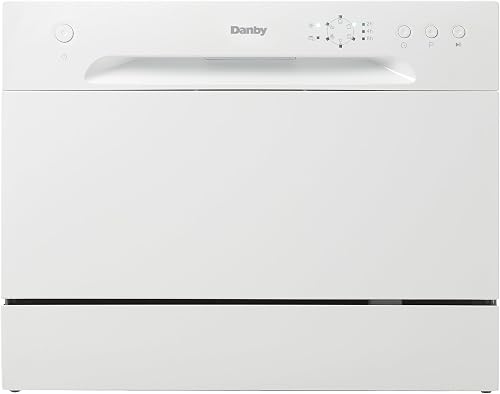
Almost every countertop dishwasher on the market ships with a faucet adapter that screws onto the end of your kitchen faucet after you remove the aerator. During a cycle, you turn the faucet to a warm setting, attach the inlet hose to the adapter, and the machine draws water on demand. When the cycle ends, you detach the hose and replace the aerator so the faucet works normally again. The Danby DDW621WDB and the COMFEE' CDC22P1BBB both use this standard adapter system, which fits most faucets with a threaded spout. If your faucet has a pull-out or pull-down sprayer head, you may need a secondary adapter, as those spouts typically do not have a standard aerator thread.
How Draining Works
The drain hose on a countertop dishwasher drops into the sink basin during operation, similar to how a portable washing machine drains. The hose is long enough to reach from the countertop unit to most sinks, but you should confirm the distance before buying. Nothing connects permanently to your drain pipe, so there is no need to cut into existing plumbing. You simply hook the hose over the sink edge or use the included hook clip, and the pump ejects water during each drain phase of the cycle. Keep the hose end submerged as little as possible to prevent siphoning mid-cycle.
What You Actually Need to Get Started
You need three things: a threaded kitchen faucet, a 120-volt standard outlet within reach, and enough counter space. Counter space is the real constraint. The NOVETE TDQR01, rated 4.4 stars across 2,400 reviews, measures roughly 16.75 by 16.84 by 18.05 inches and weighs 28 pounds, so it fits on a modest counter without blocking cabinets. Larger units like the Danby DDW621WDB run about 19.69 by 21.65 by 17.24 inches and weigh 46.3 pounds, which is more than a typical toaster oven. Make sure the counter can bear the weight before placing a full-size unit. Water and drainage hoses need a clear path to the sink, so a counter adjacent to or directly next to the sink is the practical setup.
Tank-Fill Models: A Plumbing-Free Alternative
Some compact countertop dishwashers skip the faucet connection entirely and use a built-in water tank you fill by hand. The KAPAS KPS-XWJ01, for example, operates this way, which means it works anywhere with an outlet and a few cups of water. Tank models are quieter and more portable because they have no hose to manage, but they wash fewer items per cycle and require you to refill the tank manually. If you rent an apartment where even a faucet adapter feels like a commitment, or if your faucet is incompatible with standard adapters, a tank-fill model removes the plumbing question completely. The tradeoff is smaller capacity and the added step of filling the reservoir before each load.
Rental Apartments and Installation Rules
Because countertop dishwashers connect to a removable faucet adapter and do not alter any pipes, most landlords have no grounds to object to them. You are not drilling, not connecting to supply lines behind the wall, and not touching the drain trap. When you move out, you remove the faucet adapter, replace the original aerator, and the unit leaves with you. The COMFEE' CDC22P1BBB has earned over 3,500 ratings at a 4.2-star average, and much of the positive feedback specifically notes how straightforward the faucet-adapter setup is for renters. If your lease has language about appliance modifications, it is worth a quick read, but a snap-on adapter to a faucet tip does not constitute a modification by any standard definition.
When You Might Actually Want a Permanent Connection
A small number of users do hard-plumb their countertop dishwasher using an inexpensive T-valve splitter on the hot-water supply line under the sink. This is not required, but it eliminates the step of attaching and detaching the hose before every cycle. If you run the dishwasher daily and find the connector routine annoying, a $15 to $25 diverter valve lets the machine sit connected full-time. The Danby DDW621WDB, at $486.48, is priced toward buyers who plan to use it long-term, and a permanent supply hookup pairs well with that kind of regular use. That said, the diverter valve still routes drain water to the sink, so it is not a full hard-plumb install, and most people never bother with it.
Common mistakes to avoid
- Buying a countertop dishwasher before measuring the counter space and verifying the faucet has a threaded aerator that accepts the standard adapter.
- Running the drain hose too deep into the sink basin, which can cause the machine to siphon water back during the wash cycle.
- Assuming any countertop dishwasher works with pull-out or single-hole faucets without checking the adapter compatibility first.
- Overlooking the voltage requirement. The HAVA TDJR09 and HAVA TDQR models in this category are rated at 220 volts, which does not work on a standard US 120-volt outlet without a converter.
- Ignoring the noise level rating when the unit will run in an open kitchen. Models range from around 50 dB to 62 dB, and that difference is noticeable in a small apartment.
- Forgetting to use rinse aid, which most countertop dishwashers require for spot-free drying the same as a full-size machine.
Frequently asked questions
Can I use a countertop dishwasher without connecting it to a faucet?
Yes, but only if you buy a tank-fill model that has a built-in water reservoir. Faucet-connect models need a running water source during the cycle and cannot operate from a tank. Check the product specs before you buy: if it lists a water reservoir capacity in gallons or liters rather than a faucet connection requirement, it is a tank-fill unit.
Do I need a special outlet for a countertop dishwasher?
No special outlet is needed for US-market units rated at 120 volts, which covers the majority of models available. A standard grounded 3-prong household outlet works fine. Avoid extension cords and power strips because the appliance draws sustained current during heating cycles, and a direct wall outlet is the safe choice.
Will the faucet adapter fit my kitchen faucet?
Most kitchen faucets have a standard aerator thread, and the adapters included with countertop dishwashers cover both male and female aerator sizes through interchangeable rings. Pull-out and pull-down faucets are the common exception because the sprayer head typically replaces the threaded spout entirely. If you have one of those faucet styles, look for a model that includes a pull-out faucet adapter or plan to fill a tank-fill model instead.
How much water does a countertop dishwasher use per cycle?
Most countertop dishwashers use roughly 1.5 to 3 gallons per cycle, which is significantly less than hand-washing a comparable load under a running faucet. The exact amount depends on the cycle selected and the machine capacity. Shorter express cycles use less water, while heavy-wash cycles use more. This low water use also means the inlet hose draws from your faucet for only a short burst at the start of each fill phase rather than running continuously.
Is it safe to leave the faucet adapter connected all the time?
The adapter itself is fine left on the faucet indefinitely, but you should disconnect the inlet hose from the adapter when the dishwasher is not in use. Leaving a pressurized hose connected to the machine when idle puts sustained pressure on the internal valve, and most manufacturers recommend disconnecting it between cycles. The adapter cap covers the port when the hose is removed, so the faucet still works normally.