Dishwasher Place Settings Explained: What the Number Really Means
Recommended picks
- ZLINE Kitchen and Bath
ZLINE Kitchen and Bath ZLINE DW-SS-24 Built-In Dishwasher
$818.97View on Amazon


What Counts as One Place Setting
The industry standard for a single place setting includes a dinner plate, a salad or dessert plate, a soup bowl, a teacup and its saucer, a tumbler or drinking glass, and five pieces of flatware: fork, knife, soup spoon, teaspoon, and either a salad fork or a second spoon. Serving pieces like platters, mixing bowls, and pots are not counted and must fit in remaining space after the place settings are loaded. Cookware and cutting boards are also excluded from the count. Keep this in mind when a spec says 12 place settings: it means 12 people's worth of dinner service, not 12 of every dish type you own.
How Capacity Numbers Vary Across Models
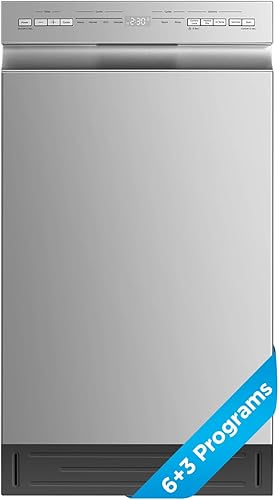
Built-in dishwashers in the standard 24-inch width typically advertise anywhere from 8 to 20 place settings depending on the rack design and tub depth. The Midea MDF18A1AST, priced around $499 with 501 customer ratings averaging 4.2 stars, lists 8 place settings in an 18-inch-wide body at 22.6 x 17.6 x 32.4 inches, making it a practical fit for apartments or small kitchens. The Honeywell HDS24SS-H lists 12 place settings in a full 24-inch footprint at $399 with 327 ratings averaging 3.8 stars, and its 42 dB noise rating puts it among the quieter options in its price range. At the higher end, the ZLINE DW-SS-24 advertises 20 place settings and runs at 52 dB, showing how rack engineering in premium models can push capacity well beyond the typical mid-range figure. Width, tub geometry, and adjustable rack systems all drive these differences more than raw machine size alone.
How Many Place Settings Does Your Household Need
A practical rule: match capacity to roughly 1.5 times your household size if you run the dishwasher every day, or 2 times your household size if you prefer to run it every other day. A couple running daily loads can manage with 8 to 10 place settings. A family of four doing a load each evening is comfortable with 12 to 14. Households of five or more, or anyone who entertains regularly, will want 16 or more to avoid hand-washing overflow. If your cooking style produces a lot of pots, pans, and large serving dishes, budget for extra open space beyond the stated place-setting count, since those items eat into capacity fast.
Why the Rated Number and Real-World Fit Often Differ
Manufacturers load test dishwashers with standard-sized dishes that are often smaller than what people actually own. Oversized dinner plates wider than 10 inches, tall pasta bowls, and large travel mugs can block spray arms or simply refuse to fit in slots designed for smaller pieces. The result is that a 14-place-setting machine may realistically hold 10 to 12 of your actual dishes per load. Adjustable upper racks and fold-down tines help recover lost space, so pay attention to whether a model advertises those features. Third-rack designs, which add a shallow tray above the upper rack for flatware and small items, can also free up meaningful space in the main racks without changing the advertised place-setting count.
Place Settings vs. Decibel Rating: Getting Both Right
Capacity and noise level are two separate specs, but they interact in practice because larger tub volumes and more powerful wash arms can raise the decibel output. Models in the 44 to 47 dB range are widely described as nearly silent during normal conversation. The 50 to 53 dB range is audible but not disruptive in most open-plan kitchens. Machines at 55 dB and above are noticeable enough to compete with background TV audio. When comparing two models with similar place-setting counts, the noise rating is often the deciding factor for open kitchen layouts. Spending a bit more to drop from 52 dB to 44 dB is a meaningful quality-of-life upgrade if the dishwasher runs while you are in the room.
Checking Capacity Before You Buy
Before committing to a model, measure your three largest everyday items: your biggest dinner plate diameter, your tallest glass, and your deepest mixing bowl. Compare these against the listed rack clearances and tine spacing in the product specs or owner manual, which most brands publish online. Confirm whether the upper rack is height-adjustable, since a fixed upper rack that sits too low will block tall glasses from fitting below and tall items from fitting above at the same time. If a model only lists capacity in cubic feet or gallons rather than place settings, those numbers are not directly comparable to the place-setting standard and require extra scrutiny. Questions about specific fit can be directed to hello@shopperscout.com.
Common mistakes to avoid
- Assuming place settings equal the total number of dishes the machine holds, rather than the count of full table services.
- Buying a small-capacity model for a large household because the price is attractive, then running two loads per night and negating any savings on the purchase.
- Ignoring plate diameter specs and discovering after delivery that oversized dinner plates hit the spray arm or hang over the tine rows.
- Treating the rated place-setting number as a guarantee rather than an engineering maximum tested with standard-sized tableware.
- Overlooking third-rack or adjustable-tine features that can recover significant usable space without changing the advertised capacity number.
- Comparing a place-settings rating on one model directly against a cubic-feet or gallon rating on another, since these are different and incompatible measurements.
Frequently asked questions
Is a higher place-setting number always better?
Not necessarily. A higher number means the rack system is engineered for more settings, but only matters if your household actually generates that many dishes per load. Buying more capacity than you need rarely hurts, but it can push you toward a larger or more expensive machine when a simpler one would do the job. Match the number to your real daily output rather than buying at the top of the range by default.
Can I fit pots and pans in a dishwasher rated for 12 place settings?
Yes, but they will reduce the number of place settings you can actually load in the same cycle. Pots, sheet pans, and large lids are not part of the place-setting count and compete for the same tub space. Most people load cookware on the bottom rack and fill the upper rack with cups and bowls, which is a practical way to maximize a single load without overloading the machine.
What does it mean when a dishwasher lists capacity in gallons or cubic feet instead of place settings?
Some brands describe interior tub volume in gallons or cubic feet rather than using the place-setting standard. These measurements reflect raw space, not how many dishes fit in the designed rack layout. A machine with 2.5 gallons of water capacity is describing water usage, not dish space, so check whether the product page also lists place settings separately before drawing comparisons.
Does a wider dishwasher always offer more place settings?
Width helps, but rack design matters just as much. A 24-inch model with a well-engineered three-tier rack system can outperform a wider machine that uses a basic two-rack layout. The ZLINE DW-SS-24, for example, lists 20 place settings in a standard 24-inch body, which is significantly more than many other 24-inch machines, because of how the interior is organized. Always compare the place-setting count directly rather than assuming width alone determines capacity.
How do I know if a dishwasher will fit my plates?
Measure your largest dinner plate across its widest point, then look for the tine spacing and lower rack clearance in the product manual or spec sheet. Most standard tines accommodate plates up to about 10.5 inches in diameter without issue, but oversized plates above 11 inches can interfere with the spray arm rotation. If the manufacturer does not publish this detail, check the Q and A section on the product page or contact the brand directly before purchasing.