How to Choose a Built-In Dishwasher
Recommended picks


Measure Before You Shop
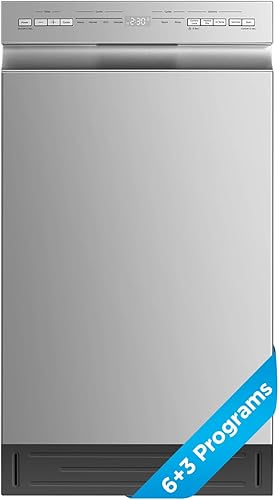
A built-in dishwasher slots into a cabinet cutout, so dimensions matter more here than with countertop appliances. The most common opening is 24 inches wide, roughly 24 inches deep, and 33.5 to 35 inches tall. Some models are designed for 18-inch-wide openings, which suits smaller kitchens or apartments. Before you order anything, measure the width, depth, and height of your space and confirm the door can fully swing open without hitting an adjacent island or cabinet. Always check the product dimensions against your actual opening, not just the nominal size.
Place Settings: How Much Capacity Do You Actually Need
Place settings tell you how many full table settings (plate, bowl, glass, silverware) a dishwasher can hold in one load. Models in this category range from 8 place settings, as with the compact Midea MDF18A1AST, up to 20 place settings, as with the ZLINE DW-SS-24. A household of two people generally gets by with 8 to 12 place settings. Families of four or more typically want 14 to 16. Buying more capacity than you need just means running the machine half-empty; buying too little means running it twice a day. Match the number to your real daily dish volume, not your worst-case dinner party.
Noise Level: The Spec That Changes How You Live
Dishwasher noise is measured in decibels, and the difference between a 42 dB machine and a 55 dB machine is substantial. At 42 dB you can carry on a normal conversation nearby; at 55 dB it starts to intrude on a TV show or phone call. The Honeywell HDS24SS-H runs at 42 dB and carries 327 ratings with a 3.8-star average at $399.99, which shows you can get genuinely quiet performance without a premium price tag. If your kitchen opens to a dining room or living space, budget for something at or below 46 dB. If the kitchen is a separate room with a door, 50 to 55 dB is usually acceptable.
Finish and Fit with Your Kitchen
Stainless steel is the most popular finish by far, and it suits most kitchen styles from traditional to contemporary. Some buyers prefer fingerprint-resistant coatings, which reduce the smudging that plain stainless steel shows on the door handle area. White and black finishes cost the same or less and are the right call if your other appliances match that palette. Matte black is available on a few models for kitchens that lean modern or industrial. Panel-ready models, such as the Bosch SHV78DM3N, accept a custom cabinet panel so the dishwasher disappears entirely into your cabinetry. Panel-ready units tend to sit at the higher end of the price range.
Price Range and What Changes at Each Level
Entry-level built-in dishwashers start around $390 and typically offer basic wash cycles, push-button controls, and noise levels in the 50 to 55 dB range. The $500 to $800 mid-range is where most buyers land, with models like the Frigidaire FFBD1831US at $803 drawing 165 ratings and a 4.2-star average. In this tier you get better noise ratings, more wash cycles, and cleaner control layouts. Above $900 you generally gain quieter operation, premium finishes, fully integrated controls, and longer warranty coverage. Spending more above $1,200 tends to buy aesthetics and brand cachet more than a dramatically cleaner wash. Set a firm ceiling before you start comparing or it is easy to talk yourself into features you will rarely use.
Common mistakes to avoid
- Buying on price alone without checking noise level, then regretting it every evening.
- Not measuring the cabinet opening before ordering, leading to a return or a costly installation adjustment.
- Confusing nominal size (24 inch) with actual product dimensions, which can vary by an inch or more.
- Choosing a fully integrated control panel without realizing you cannot see the remaining cycle time at a glance.
- Overbuying capacity for a small household and running a mostly empty machine every cycle.
- Ignoring the voltage spec: a few models require 115 volts while most run on 120 volts, and the wrong outlet means the machine does not start.
Frequently asked questions
What is a good noise level for a built-in dishwasher?
Most appliance guides put the comfortable threshold at 44 dB or below for open-plan kitchens. At that level the machine is quieter than a normal conversation and easy to run while watching television in the next room. If your kitchen has a door you can close, 48 to 52 dB is usually tolerable. Models above 55 dB are noticeable and can feel disruptive in smaller homes.
How many place settings do I need?
A place setting covers a full set of dishes for one person, so 12 place settings handles a family of three to four comfortably when you run the machine once a day. Couples or singles usually do fine with 8 to 10. If you cook elaborate meals or entertain regularly, 14 to 16 gives you a useful buffer without going overboard.
What is the difference between fully integrated and semi-integrated controls?
Fully integrated dishwashers hide all controls on the top inner edge of the door, so the exterior is a plain panel with no visible buttons. Semi-integrated models put a visible control strip across the top of the front face. Fully integrated looks cleaner but requires you to open the door to check settings, while semi-integrated keeps controls accessible at a glance.
Do I need a professional to install a built-in dishwasher?
Most built-in dishwashers connect to a standard water supply line and a drain line under the sink, plus a 120-volt electrical outlet. If those connections already exist from a previous dishwasher, a handy homeowner can often complete the swap in a few hours. A first-time install without existing plumbing lines, or any job that requires moving a drain or adding a dedicated circuit, is best left to a licensed plumber or electrician.
Can I get a built-in dishwasher in a finish other than stainless steel?
Yes. White and black are common at every price point, and some brands offer matte black, satin stainless, or panel-ready options that accept a custom cabinet front. The GE GDT670SMVES comes in solid black, for instance, and the ZLINE DWMTZ-WM-24-MB ships in white matte or matte black. Panel-ready models give you the most flexibility but add the cost of a custom panel on top of the unit price. Contact hello@shopperscout.com if you have questions.